Press Release
What Actually Happens When You Swap Crypto

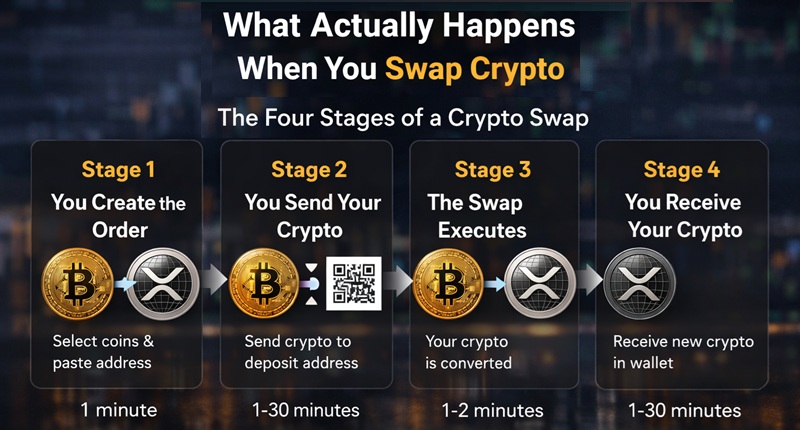
You pick two coins, paste an address, hit confirm, and a few minutes later, different crypto shows up in your wallet. It works. But have you ever wondered what’s actually going on behind that simple interface?
Understanding the process doesn’t just satisfy curiosity. It helps you make better decisions about timing, fees, and what to do if something doesn’t go as expected.
The Four Stages of a Crypto Swap
Every swap, whether it’s Bitcoin to Ethereum or USDT to Solana, follows the same basic sequence. Let’s walk through each one.
Stage 1. You Create the Order
When you select your sending coin, your receiving coin, and paste your destination wallet address, the platform creates an order. At this point, it calculates an exchange rate based on current market conditions and shows you an estimate of what you’ll receive. If you’ve chosen a fixed rate, that number is locked for a short window, usually 10 to 30 minutes. If you’ve chosen a floating rate, the final amount will depend on the market price at the time the swap actually executes.
The platform then gives you a unique deposit address. This is where you’ll send your crypto to initiate the swap. Think of it like a one-time mailbox created specifically for your transaction.
Stage 2. You Send Your Crypto
You open your wallet and send the agreed amount to that deposit address. This is a normal blockchain transaction, so it’s subject to the same network fees and confirmation times as any other transfer. On Bitcoin, you might wait for one to three confirmations, which can take 10 to 30 minutes. On faster networks like Tron or Solana, this step might take under a minute.
This is also the point of no return. Once you broadcast the transaction to the blockchain, it cannot be reversed or cancelled. That’s why checking your amounts and addresses before sending matters so much.
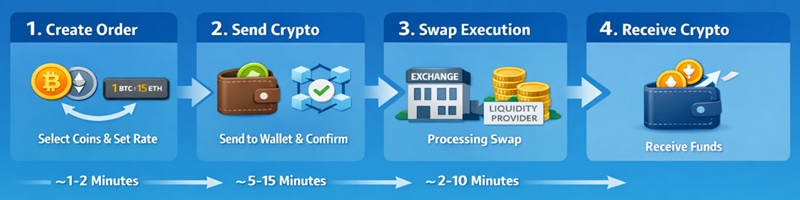
Stage 3. The Swap Executes
Once the platform confirms your deposit on the blockchain, the exchange takes place. This is where the platform works with liquidity providers to convert your crypto into the requested coin. Paysmaker handles this automatically. You don’t need to interact with the liquidity providers yourself or understand the routing. The platform finds the best available rate from its providers and executes the trade.
The speed of this step depends on the platform’s infrastructure. On a well-built service, it’s nearly instant once your deposit is confirmed. The bottleneck is almost always the blockchain confirmations, not the swap itself.
Stage 4. You Receive Your Crypto
After the swap executes, the platform sends the new crypto to the wallet address you provided at the start. This is another blockchain transaction, so it needs to be confirmed on the receiving network. Again, confirmation times vary by network.
Once confirmed, the swapped funds appear in your wallet. The whole process, from sending to receiving, typically takes 5 to 60 minutes, depending on the networks involved.
Why Swaps Sometimes Take Longer Than Expected
If you’re sitting there watching the clock, it helps to know what can cause delays.
- Network congestion. When a blockchain is busy, transactions queue up. Bitcoin and Ethereum are the most common culprits here. During high-traffic periods, even simple transfers can take longer than usual. This isn’t a platform issue. It’s a network issue.
- Low transaction fees from your wallet. If your wallet set a low network fee on the outgoing transaction, miners or validators may deprioritise it. Some wallets let you adjust this. If speed matters, make sure you’re not sending with the minimum possible fee.
- Confirmation requirements. Different platforms require different numbers of blockchain confirmations before they process your deposit. Bitcoin typically needs 1 to 3 confirmations, which can mean 10 to 30 minutes. Some altcoins require more.
If your swap seems stuck, the first thing to do is check the transaction hash on a block explorer. If the transaction is confirmed but the swap hasn’t been processed, contact the platform’s support with your order ID or transaction hash. If the transaction itself is still pending on the blockchain, you just need to wait.
Fixed vs Floating Rates in Context
Now that you understand the stages, the choice between fixed and floating rates makes more sense. A floating rate is calculated at Stage 3, when the swap actually executes. The market might have moved since you created your order at Stage 1. A fixed rate is calculated at Stage 1 and held for you, regardless of what happens between then and Stage 3. The trade-off is a small premium for that certainty.
For quick swaps on fast networks, the difference is usually minimal because there’s not much time for the market to move. For slower networks like Bitcoin, especially during volatile periods, locking in a fixed rate gives you more predictable results.
Why Understanding This Matters
When you know what’s happening at each stage, you stop guessing and start making better decisions. You know why a Bitcoin swap takes longer than a Tron swap. You understand why your wallet’s fee setting affects speed. You can tell the difference between a platform delay and a network delay. And you know exactly what information to provide if you ever need to contact support.
Most of the anxiety around crypto swaps comes from not knowing



Solo Developer Takes Three-Year Retro Arcade Project On-Chain With $GGLIDE Launch on Pump.fun

GGD (Global Gold DAO) Launches Tokenized Physical Gold Ecosystem on BNB Chain

Ave AI Completes Arc Integration Ahead of September 16 Mainnet Launch

5 best crypto exchanges of 2022

Blockchain Applications made Simpler with Dappatoz

Meet TABOO, the unique token that gives reward for every transaction
-
 Press Release5 years ago
5 best crypto exchanges of 2022
-
 Press Release6 years ago
Blockchain Applications made Simpler with Dappatoz
-
 Press Release5 years ago
Meet TABOO, the unique token that gives reward for every transaction
-

 Bitcoin7 years ago
Bitcoin’s Gravity: How Idea-value Feedback Loops Are Pulling People in
-
 Press Release6 years ago
Cloud Mining: How Multimine is Making Crypto Mining Operation More Seamless.
-
 Press Release6 years ago
SHA-256 – The best combination of Bitcoin mining, Cloud, and affordable Hash Power
-

 Press Release7 years ago
LISTING OF LEVL ON A SECOND EXCHANGE
-

 Press Release7 years ago
EXMR FOUNDATION NETWORK “LABS OF DAPPS & PROJECTS” MORE INFO.